
How to Move a Room Cooler When You Shift House
To move a room cooler, also called a desert cooler, switch it off, unplug it, drain every drop from the tank, take the pads out and let them dry, and carry the empty body upright with two people. Do not tip it while it is still full, and do not pack wet pads against a sofa. Here are the steps.
A room cooler is not a fridge and not a water dispenser. It has no gas compressor. It is also not a ceiling fan: the bulky part is the water tank and the pads, not the blades.
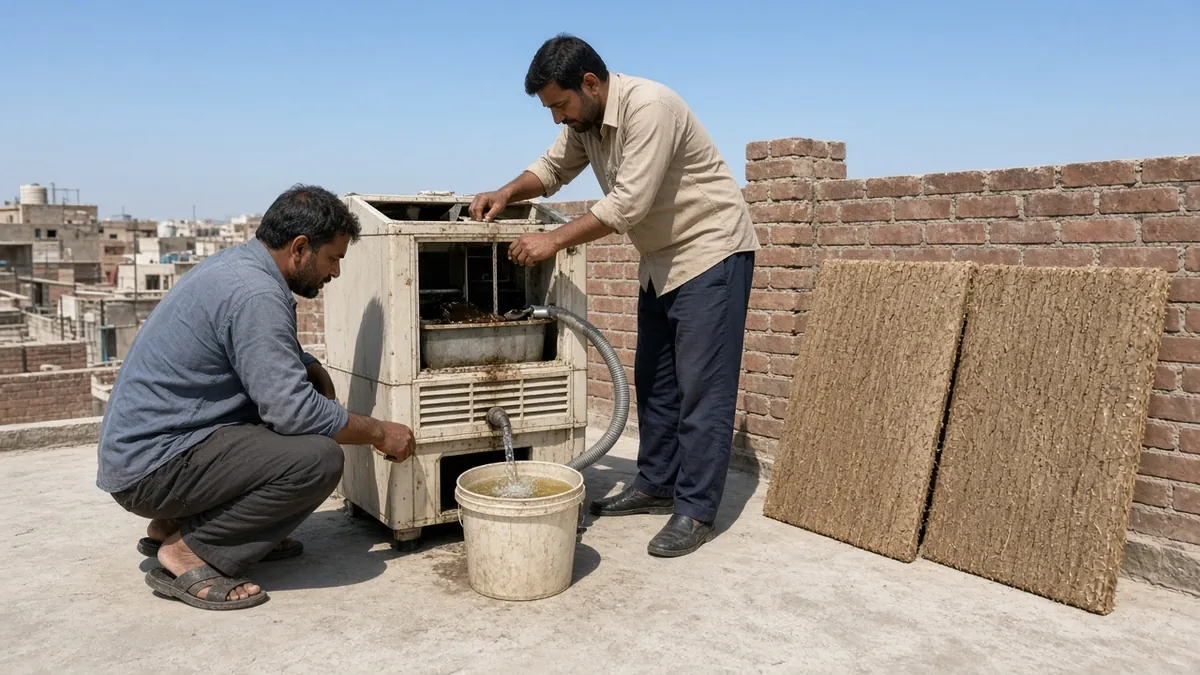
Empty it before anyone lifts it
- Switch the cooler off at its own switch and at the socket, then unplug it.
- Pull the water inlet pipe off so it cannot leak on the stairs.
- Open the drain and empty the tank into a bucket or a floor drain. A full tank is heavy and will spill on the first tilt.
- Scoop out the last water, silt and mosquito debris. Tip the body only when the tank is already empty.
- Wipe the tank so it does not smell in the truck.
The pads
Slide the grass or wood-wool pads out. If they are soaked, stand them on a rooftop or balcony until they stop dripping. Wet pads stain fabric and grow mould inside a carton. Dry pads can go back on the cooler for the journey, or lie flat in their own carton. Do not fold a dry grass pad hard; it cracks.
Pump and fan
If the pump lifts out, bag it with its short pipe and tape the bag inside the tank so it cannot vanish. The fan stays in the body. Do not grab the cooler by the front grill; the grill bends. Lift by the side frames.
Carrying it off the roof or out of a window
Many coolers live on a rooftop stand, in a window, or on a balcony bracket. Two people lift it. One stays on the roof side until the other has the weight. Measure the stair turn before you start. A cooler that will not fit the stair is taken down the way it went up, often through the balcony, and that is planned on the survey, not invented on loading day.
On the truck
Stand the cooler upright against the wall and strap the body, not the grill. Nothing sits on top of it. The pads, if they are travelling loose, stay in their own carton so the fibres do not work into a sofa or a mattress. A cooler laid on its face crushes the grill and can still leak the last of the water onto the carton underneath.

At the new house
Put it where the air can leave the room: a window, a verandah, or a rooftop stand with a shade. Fit the pads, fill the tank with clean water, and run the fan on its own for a minute before you switch the pump on. Do not leave the pump running on an empty tank; the pump is meant to move water, not to spin dry. If the pump only hums, switch it off and check that the inlet is not blocked with silt from the old house.
If it was a window unit
The new window may be a different width. Do not force the body into a frame that is too small. A stand or a trolley cooler is safer than cutting a new opening on moving day. Tell the crew on the survey if the cooler is built into the window, so they bring the right people for that lift.
Conclusion
A room cooler arrives usable when the tank is empty, the pads are dry, and the body rides upright with the grill uncrushed. Put it on the list when you book house shifting, or send a photo of where it sits, roof or window, to +92 312 6939758.
Frequently Asked Questions
How do I move a room cooler in a house shift?
Switch it off, unplug it, drain the tank, remove and dry the pads, and carry the empty body upright with two people.
Can I move a cooler with water still in it?
No. Drain it first. A full tank is heavy and spills as soon as the body tilts on the stairs.
Should the pads stay on?
Only if they are dry. Wet pads stain furniture and mould in a closed truck. Dry pads can stay on or travel flat in their own carton.
Is a desert cooler the same as a fridge?
No. A desert cooler uses water and a fan. It has no gas compressor, but the tank still has to be empty before the lift.
Can one person carry it down the stairs?
No. Two people lift it by the side frames, not by the grill. A roof or window unit is planned on the survey.
What if the pump does not run at the new house?
Switch it off, check the tank has water, and clear silt from the pump inlet. Do not leave a dry pump switched on.
